

Global Talent Trends – March 2026: Year-End "Career Refresh" Accelerates as Electronics & Machinery and Finance Sectors Post Exceptional Growth
Daijob.com, a dedicated bilingual career platform operated by Human Resocia Co., Ltd., has released the Daijob.com Jobseeker Trends Report for March 2026, highlighting the latest movements in the global talent market.
For reference, the February 2026 edition is available here: Global Talent Trends – February 2026: Creative and Executive Sectors Rebound Ahead of Fiscal Year-End as Manufacturing Hits a Record YoY High
About the Global Talent Data
In this report, “global talent” refers to individuals registered on Daijob.com who possess business-level proficiency or higher in both English and Japanese. The analysis focuses on users who were active during the reporting period—specifically, those who either submitted a job application or showed interest in scout emails.
Key Highlights
- Month-over-Month (MoM) Analysis: A Synchronized Surge Across All Sectors Ahead of the Fiscal Year-End.
- Year-over-Year (YoY) Analysis: Manufacturing and Finance Lead the Market Driven by Structural Shifts.
Month-over-Month Analysis: A Synchronized Surge Across All Sectors Ahead of the Fiscal Year-End
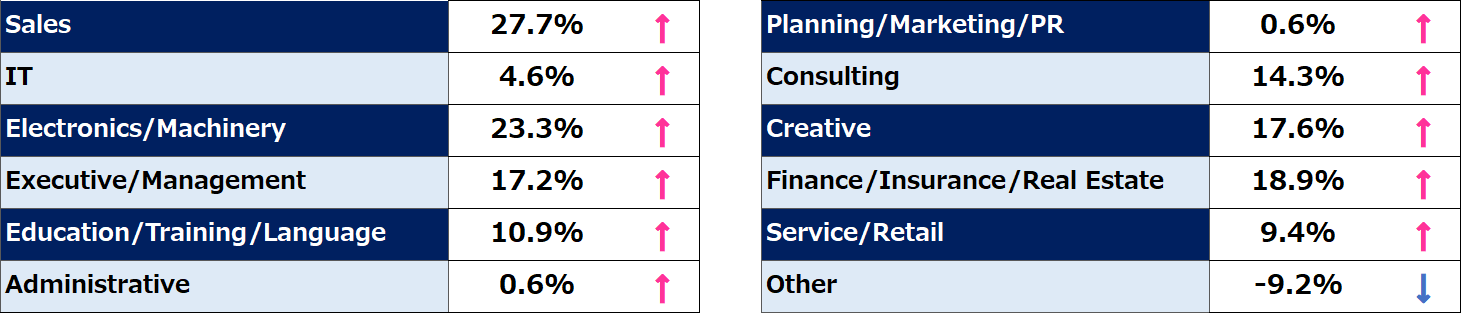
The March 2026 Month-over-Month (MoM) data reveals a significant, synchronized increase in jobseeker activity across all major professional categories. Substantial double-digit growth was observed in Sales (+27.7%), Electronics & Machinery (+23.3%), Finance/Insurance/Real Estate (+18.9%), Creative (+17.6%), and Executive/Management (+17.2%).
Following a period of "strategic holding patterns" in January and February, candidate engagement has accelerated sharply as professionals position themselves for the start of the new fiscal year in April. Furthermore, IT-Related roles continued their steady expansion with a +4.6% increase, indicating a market that is operating at high velocity across the board.
Jobseeker Trends Comparison – Month-over-Month, March 2026
Year-over-Year Comparison: Structural Dominance in Manufacturing and Finance Amid Market Maturation
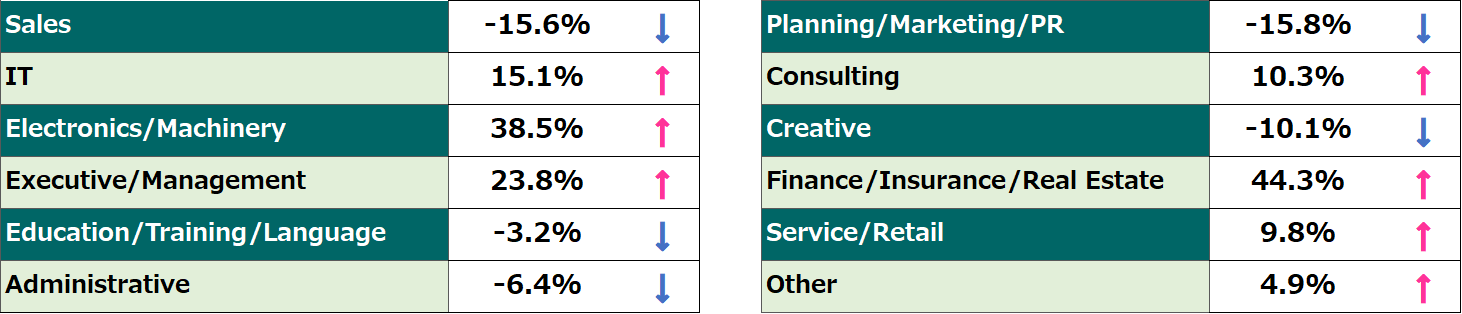
A Year-over-Year (YoY) analysis reveals a sharp divergence in sector performance, underscored by exceptional growth in Finance/Insurance/Real Estate (+44.3%) and Electronics & Machinery (+38.5%). Solid gains were also recorded in Executive/Management (+23.8%) and IT-Related (+15.1%) categories, reinforcing the long-term expansion of the global talent pool.
Conversely, contractions in Planning/Marketing/PR (-15.8%) and Sales (-15.6%) suggest a period of market maturation. Following the "DX-driven hiring bubble" of the previous year, we are observing a transition toward a "quality-first" selection process. This shift indicates that while the overall volume of candidates in these sectors has normalized, the demand for highly specialized, top-tier talent remains the primary focus for leading organizations.
Jobseeker Trends Comparison – Year-over-Year, March 2026
Analysis: Fiscal Year-End "Career Totals" and the Shift Toward New Industrial Foundations
The March 2026 data serves as both a conclusion to the 2025 fiscal year and a vivid reflection of dramatic shifts in Japan’s industrial structure.
1. The "Resurgence of Manufacturing" and Global Supply Chain Realignment
The extraordinary growth in Electronics & Machinery (+23.3% MoM, +38.5% YoY) is driven by the large-scale "reshoring" of manufacturing to Japan and accelerated investment in frontier technologies. As highlighted in the Ministry of Economy, Trade and Industry (METI) "White Paper on Manufacturing," the strengthening of domestic production bases—particularly in semiconductors and clean energy—has elevated the value of bilingual engineers capable of cross-border coordination to unprecedented levels.
March traditionally marks the period where Japanese firms finalize their fiscal year-end objectives and confirm headcount budgets for the upcoming cycle. This release of latent demand has triggered a surge among professionals who were previously in a "strategic holding pattern." We categorize this movement not merely as job-seeking, but as a fundamental reallocation of human capital toward the next generation of Japan’s core industries, such as next-gen mobility and smart factory integration.
2. Financial Sector: Responding to "Structural Inflation" and the Migration of High-Level Specialists
The explosive growth in Finance/Insurance/Real Estate (+44.3% YoY) has evolved beyond a temporary trend into a structural shift. Following the definitive transition to a "positive interest rate" environment in 2025, the demand for specialists capable of overhauling legacy investment models has reached a critical threshold. As professionals closely monitor Bank of Japan (BoJ) policy shifts, we are seeing a migration of talent toward foreign asset management firms and emerging FinTech players that offer premium compensation for the ability to restructure global portfolios.
A YoY increase of over 44% reflects a strong mandate among jobseekers to optimize their skill sets for this new financial paradigm. Within the Real Estate sector, bilingual professionals specializing in asset liquidation and hedging strategies amidst rising interest rates are using the fiscal year-end—and the conclusion of bonus cycles—as a strategic pivot point to transition toward high-growth mandates.
3. Executive Leadership: Strategic "Release" and Organizational Refresh for the New Fiscal Year
The Executive/Management sector, which saw a decline during January's "strategic holding pattern," has rebounded sharply with a 17.2% MoM increase in March. Consistent with broader market data regarding April organizational restructuring, this surge indicates that leaders who have fulfilled their fiscal-year mandates are now officially entering the market to seek new transformative opportunities.
A notable trend this season is the high demand for leaders with expertise beyond traditional "Management." Professionals with proven track records in Sustainability (ESG) Management and AI Governance are securing high-value transitions. This increased liquidity at the executive level serves as clear evidence that Japanese corporate governance is evolving rapidly toward global standards.
4. IT Talent: From "Implementation" to "Strategic Integration" and Stable Growth
IT-Related roles (+15.1% YoY) have maintained a consistent upward trajectory throughout the year. This stability indicates that in the post-"2025 Cliff" era, IT is no longer viewed as a series of isolated projects, but as essential infrastructure for business continuity. The uptick in March is largely driven by engineers who, having completed major legacy system overhauls, are now migrating toward organizations focused on the next frontier: enterprise-wide Generative AI integration and the fundamental strengthening of cybersecurity frameworks.
While the chronic shortage of IT talent (as noted in the Ministry of Health, Labour and Welfare’s "Analysis of Labour Economy") persists, candidate priorities are shifting. Professionals are increasingly prioritizing "upstream" opportunities—moving away from pure development and toward roles that emphasize how technology is translated into tangible business value.
5. Sales and Creative Sectors: The Bifurcation of Value and "Quality Selection"
The Year-over-Year (YoY) contractions in Sales (-15.6%) and Planning/Marketing/PR (-15.8%) should be interpreted as a fundamental "transition toward quality." As AI-driven sales tools and generative AI content production became standardized between 2025 and 2026, the demand for generalized skill sets has diminished. However, the 27.7% MoM surge in Sales candidates in March highlights a critical counter-trend.
This spike represents high-caliber professionals—those capable of leveraging AI while delivering high-touch, human-centric solution sales—entering the market ahead of the new fiscal year. We are seeing a decisive shift from Volume to Quality. For employers, the reduced overall talent pool in these sectors necessitates more sophisticated selection criteria to ensure they capture the high-class talent that is now becoming mobile.
The Year-over-Year (YoY) contractions in Sales (-15.6%) and Planning/Marketing/PR (-15.8%) should be interpreted as a fundamental "transition toward quality." As AI-driven sales tools and generative AI content production became standardized between 2025 and 2026, the demand for generalized skill sets has diminished. However, the 27.7% MoM surge in Sales candidates in March highlights a critical counter-trend.
This spike represents high-caliber professionals—those capable of leveraging AI while delivering high-touch, human-centric solution sales—entering the market ahead of the new fiscal year. We are seeing a decisive shift from Volume to Quality. For employers, the reduced overall talent pool in these sectors necessitates more sophisticated selection criteria to ensure they capture the high-class talent that is now becoming mobile.
Summary
March 2026 saw an increase in jobseeker activity across nearly all sectors, marking a period where momentum toward the new fiscal year reached its zenith. The exceptional growth in Electronics & Machinery and Finance in particular suggests that Japan’s industrial structure is undergoing a major turning point.
Strategic Recommendations — Navigating the Fiscal Transition
- For Employers: The market is currently populated by high-motivation global talent eager to deliver results in new environments for the 2026 fiscal year. To remain competitive, organizations must look beyond rigid April start dates and offer flexibility. Crucially, companies must present a clear vision of how a candidate’s specific expertise will drive business growth to secure top-tier assets in a high-demand environment.
- For Jobseekers: With liquidity rising across all sectors, this is the optimal moment to align your career trajectory with dominant market trends—namely manufacturing reshoring, interest rate adaptations, and post-DX strategic integration. In sectors where the total candidate volume has decreased (such as Sales and Marketing), professionals who can demonstrate rare, specialized expertise have significant leverage to negotiate premium terms and conditions.

Upcoming Opportunity: Japan’s Largest Career Fair for Global Talent — June 12, 2026 (Fri)
The next Daijob Career Fair, Japan’s premier recruitment event dedicated to global professionals, is scheduled for Friday, June 12, 2026.
Participating organizations consistently report exceptional outcomes, with over 90% of exhibitors meeting high-potential candidates with strong hiring prospects.
If your organization is looking to accelerate its talent acquisition strategy, we encourage you to contact us for further participation details.
https://biz.daijob.com/en/lp/careerfair