

Global Talent Trends – January 2026: Finance and Service Sectors Surge as IT Talent Liquidity Accelerates in the Post-"2025 Cliff" Era
Daijob.com, a dedicated bilingual career platform operated by Human Resocia Co., Ltd., has released the Daijob Jobseeker Trends Report for January 2026, highlighting the latest movements in the global talent market.
As the new year business cycle in Japan begins to accelerate, this report provides key insights into how the market is shifting—offering critical data for both employers and jobseekers navigating the current landscape.
For reference, the December 2025 edition is available here:
About the Global Talent Data
In this report, “global talent” refers to individuals registered on Daijob.com who possess business-level proficiency or higher in both English and Japanese. The analysis focuses on users who were active during the reporting period—specifically, those who either submitted a job application or showed interest in scout emails.
Key Highlights
Financial and Retail sectors drive New Year liquidity, with Finance/Insurance/Real Estate surging 31.1% Month-over-Month (MoM).
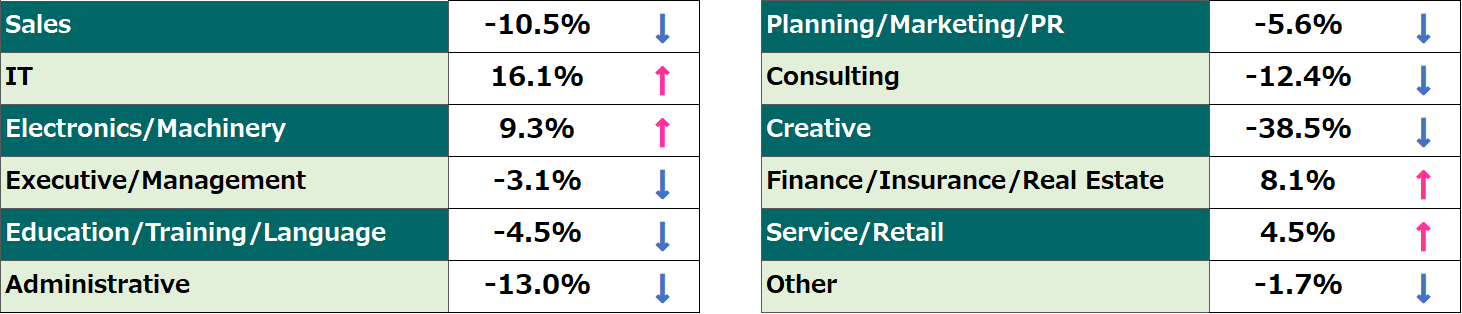
Structural demand for IT talent remains resilient with a 16.1% Year-over-Year (YoY) increase, while the Creative sector undergoes a "skills redefinition" period (-38.5% YoY).
Month-over-Month Comparison: New Year Career Shifts Led by Finance and Service Sectors
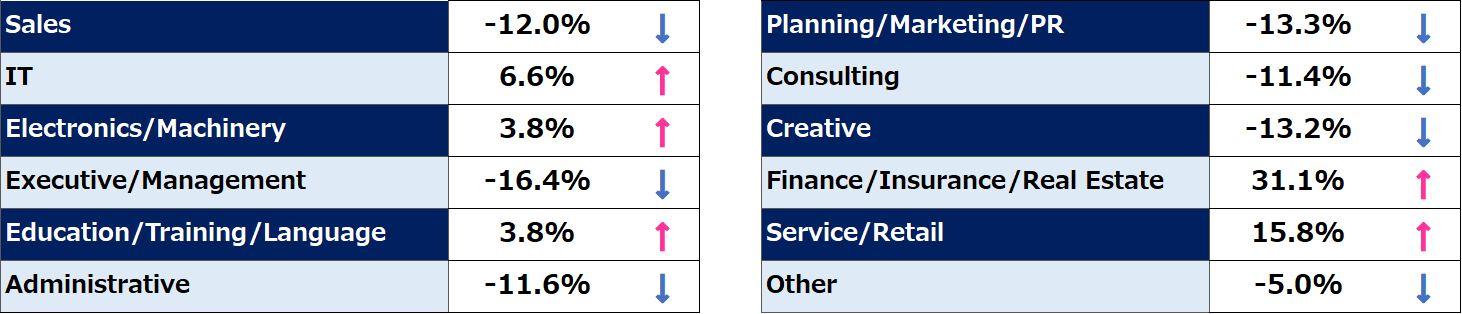
Comparing January 2026 with the previous month (December 2025), a sharp increase in activity was observed in Finance/Insurance/Real Estate (+31.1%) and Service/Retail (+15.8%). The IT-related sector, which represents the largest volume of jobseekers, also maintained steady growth at +6.6% MoM.
Conversely, the Executive/Management (-16.4%) and Marketing/PR (-13.3%) categories saw a temporary decline. We interpret this as a "project consolidation" phase, where high-level professionals prioritize the completion of current fiscal-year mandates before initiating a career transition.
Jobseeker Trends Comparison – Month-over-Month, January 2026
Year-over-Year Comparison: Resilient IT Demand and the "Strategic Redefinition" of Creative Roles
An analysis of Year-over-Year (YoY) data reveals that long-term growth trends remain robust. IT-related roles maintained double-digit growth at +16.1% YoY, confirming a persistent and structural demand for global technical talent. Similarly, the Electronics & Machinery sector continued its upward trajectory with a 9.3% increase.
In contrast, Creative roles experienced a significant contraction of 38.5% YoY. We categorize this not as a lack of demand, but as a "Skills Redefinition Period" (Reskilling Phase). As Generative AI tools rapidly enhance operational efficiency, the market’s requirement is shifting from basic production skills to "Strategic Creativity." This decline suggests that jobseekers in this field are currently recalibrating their skill sets to meet these higher professional standards.
Jobseeker Trends Comparison – Year-over-Year, January 2026
Analysis: The Reallocation of Expertise in the Early 2026 Labor Market
1. Finance and Real Estate: Adapting to a "Positive Interest Rate" Environment
The extraordinary 31.1% MoM surge in Finance/Insurance/Real Estate is underpinned by a significant industry realignment following the shift in domestic interest rate policy. As Japan moves away from the "zero-interest-rate era," both foreign and domestic firms are facing a critical need to overhaul their asset management, risk mitigation, and hedging strategies.
This has triggered a spike in demand for bilingual professionals who can navigate these "normalized" market conditions. Particularly in the Real Estate sector, rising capital costs are necessitating immediate portfolio restructuring. We are seeing a high volume of asset managers and cross-border deal-makers entering the market in search of premium opportunities where their ability to provide transparent, global-standard reporting is highly valued. This is a "rebalancing of expertise" as the market adapts to a new economic reality.
2. The Post-“2025 Cliff” Landscape: Strategic Mobility in IT
Having passed the critical threshold of the "2025 Cliff," the 16.1% YoY increase in IT-related activity signals a shift from emergency system updates to "Post-DX" strategic development. A clear bifurcation has emerged: firms that successfully modernized their legacy infrastructure are now "winners" seeking to integrate Generative AI and autonomous agents into their core systems.
The talent currently in motion consists of high-caliber engineers and project managers who successfully spearheaded these system overhauls. They are now seeking "Phase 2" projects—highly advanced mandates that offer greater autonomy and the chance to work with cutting-edge architectures. For bilingual IT talent, their role has evolved into that of a "Strategic Bridge," localizing global innovations for the Japanese enterprise. This January uptick suggests that the first wave of DX is complete, and the architects of that change are now migrating toward the next frontier of disruptive innovation.
33. Qualitative Transformation in Service and Hospitality: The Rise of "High-Touch" Professionals
The 15.8% MoM increase in the Service/Retail sector represents far more than a simple recovery from labor shortages. We are witnessing a fundamental shift in the caliber of talent being demanded as the inbound tourism market transitions from mass-market consumption to exclusive, high-value experiences.
Today’s bilingual global talent is moving away from traditional frontline roles and toward positions that emphasize Customer Success and the maximization of Life Time Value (LTV). Whether in luxury hospitality, private banking, or high-end concierge services, there is an intensifying pursuit of professionals who combine cross-cultural fluency with sophisticated service standards. This January growth suggests that jobseekers are strategically "trading up," selecting employers that value their linguistic and cultural expertise as a premium asset rather than an entry-level skill.
4. Executive and Administrative Resilience: A Strategic Holding Pattern for Q4
The decline in the Executive/Management (-16.4% MoM) and Administrative (-11.6% MoM) categories might appear at first glance to be a market stagnation. However, from a consultative perspective, this reflects a highly rational "Strategic Holding Pattern" common during the Japanese fiscal year-end.
In a market where the majority of companies close their books in March, leaders and department heads are currently focused on operationalizing next-year business plans and securing current-year targets. Departing at this juncture carries significant "reputational risk." Furthermore, macro-economic data confirms that the April fiscal start remains the primary window for organizational restructuring and the launching of new initiatives. Executive candidates are currently engaging in confidential talent mapping and headhunter consultations, building momentum behind the scenes for a major transition in the second quarter.
Outlook — Navigating the Strategic Reallocation of Expertise in 2026
The January 2026 data indicates a high-conviction start to the year, characterized by a large-scale reallocation of bilingual capital across the Japanese economy. As the market moves beyond the "2025 Cliff," the focus has shifted toward long-term organizational resilience and the professionalization of the service economy.
- For Employers: A high-caliber pool of Finance and IT talent is currently active, seeking the next phase of technological and economic evolution. Organizations must articulate a visionary "Post-DX" roadmap and demonstrate a commitment to professional autonomy to secure these top-tier assets.
- For Jobseekers: The market is currently rewarding the "Expertise-Solution" model. Rather than presenting skills in isolation, professionals who can define their language and technical capabilities as specific solutions to complex business challenges (e.g., interest rate hedging, AI integration, or high-end customer success) will find significant leverage for career advancement.
Coming Up: Japan’s Largest Career Fair for Global Talent – March 6, 2026 (Fri)
The next Daijob Career Fair, Japan’s premier recruitment event dedicated to global professionals, is scheduled for Friday, March 6, 2026.
Participating organizations consistently report exceptional outcomes, with over 90% of exhibitors meeting high-potential candidates with strong hiring prospects. The upcoming fair will feature specialized zones for "Foreign-Capital Companies" and "Global Opportunity Firms," providing a high-impact platform to engage directly with Japan's most mobile and skilled bilingual talent.
If your organization is looking to accelerate its talent acquisition strategy, we encourage you to contact us for further participation details.